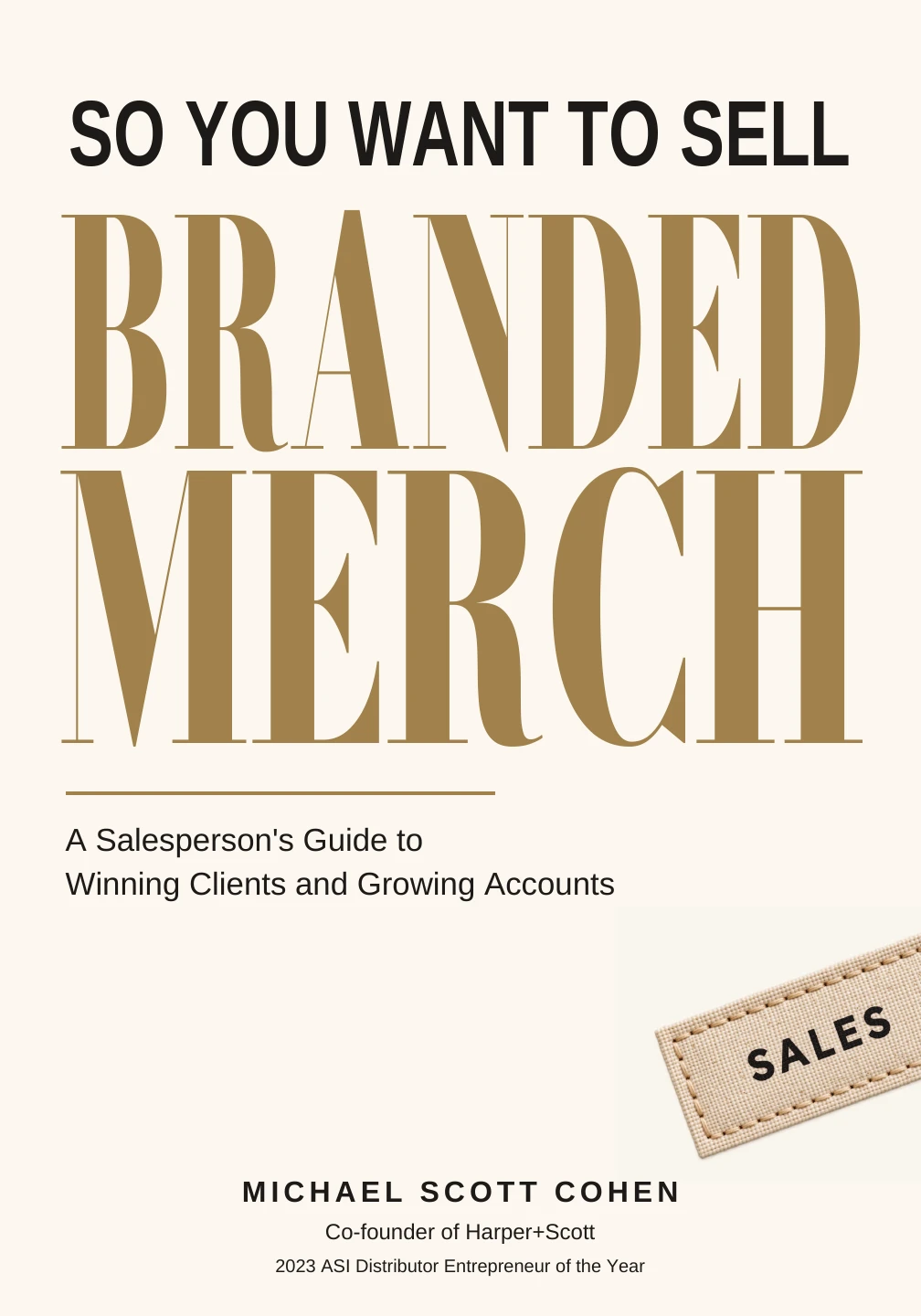
So You Want to Sell Branded Merch
Put the book
to work.
Print a worksheet. Adapt a prompt. Follow a source.
Everything here is yours to use alongside the book.
Free reader resources. No email or signup required.
A note from Michael
Use these with a real opportunity. Start with the part of the work in front of you.
Michael Scott Cohen
01 / The companion workbook
A fresh sheet.
A real opportunity.
The same sixteen exercises included in the book, ready to print whenever you need them. The pricing exercise includes answers.
Printable exercises
Companion workbook · PDF
Includes pricing answers
Print copies for your own use.
02 / Twenty starting points
Give AI a useful
assignment.
Open the prompt for the job you need to do. Gather the inputs, copy it and make it your own.
How to use these prompts
Pick the job you need to do. Copy the prompt and replace the bracketed instructions with your own information. The input line tells you what to gather. If something is unknown, say so. Give the tool a few examples of your writing when you want it to sound like you.
Use your company's approved AI tools and only information you are permitted to put into them. Research needs accessible sources or material you supply. If a file or link cannot be read, the tool should tell you. Open important sources yourself, verify the facts and recalculate the numbers before you use an answer. A polished draft still needs your review and the company's actual approvals.
Try the first answer, explain what it missed and improve the instruction. These prompts are starting points, not automatic messages or approved commitments. Save the version that works for your job. Tool features and access vary; the included resource does not include an AI subscription.
01Build a prospect list worth working
Start with a niche your team can serve, then find a reason to call.
Have ready: Niche, geography, team capabilities and company sources or a research tool with web access.
I sell branded merchandise, and I want to go deeper in [niche] in [geography]. Here is what our team does well: [capabilities]. Help me find up to 15 companies with a relevant opening, such as an acquisition, new location, event, product launch or employee initiative. Use current public sources and give me the source and date for each fact. For each company, explain why we might be useful, which department to investigate and what I still need to learn. Separate the actual event from your suggested merch opportunity. If you can't verify 15, give me fewer. Don't make the list look complete by making things up.
Before you use it: An acquisition is a reason to investigate. It is not a confirmed merch budget.
02Find the person behind the opportunity
The person buying merch usually has another job title.
Have ready: Target company, buying occasion, public team information and a permitted contact export.
I'm going after [company] for [occasion]. Help me work out who might own this project. Use [company sources] and [permitted contact list]. Consider the events, marketing, loyalty, HR or purchasing team based on the actual need. Show confirmed names and roles separately from roles we still need to find. If my contacts suggest a possible introduction, tell me what to verify before asking. Don't assume a LinkedIn connection means a close relationship. Don't guess email addresses. Give me a short introduction request that explains why the conversation could be useful to the person receiving it.
Before you use it: Verify the person's current role and your relationship with the proposed introducer.
03Write an opening someone can answer
Give the buyer a reason to talk before sending the company history.
Have ready: Verified company trigger, buyer role, a relevant capability and your writing samples.
Help me write a first email to [person and role] at [company]. Here is what caught my attention: [verified fact]. Here is how our team could help: [supported capability or relevant work]. Keep it under 100 words. Start with their business and ask one useful question about how they handle this need. Make it sound like someone who would be good to work with. Use [writing samples] for my tone. Give me two subject lines and one email. Don't add compliments I haven't earned the right to give, client names I didn't supply or a fake relationship. I want to start a conversation.
Before you use it: Would this person know why you chose them after reading the first two sentences?
04Make the next follow-up useful
Keep reaching out with something connected to the buyer's situation.
Have ready: Outreach history, actual replies, current date and known planning dates.
Here is my outreach history with [prospect], including what they actually said: [history]. Today is [date]. Help me decide the next useful contact. If they gave us a planning date, work around it. If they haven't replied, suggest a relevant reason to return and when to pause this sequence. Respect a request to stop. Draft the next message in my tone, then outline two possible follow-ups that depend on what happens next. Use a real resource or idea we can provide. Don't send three versions of 'just checking in.' Mark any sample or information I need to prepare before I make the offer.
Before you use it: A planned follow-up belongs on your calendar. It is not a scheduled or sent message.
05Get ready for the meeting
Walk in knowing enough to ask better questions.
Have ready: Meeting purpose, attendee list, prior conversations and dated company sources.
I'm meeting [company] on [date] with [attendees and known roles]. Here are the meeting purpose, earlier conversations and company sources: [materials]. Give me a one-page brief I can read before I walk in. Explain the brand, its customers, relevant initiatives and what we already know about this project. Cite current business facts and dates. Identify possible goals or KPIs as questions to confirm, not facts about the buyer. Suggest five questions worth asking and samples from [our actual work] that could make the conversation useful. Include one adjacent capability to bring in case the meeting goes somewhere unexpected.
Before you use it: Check the attendees and dates. Bring the extra capability because it fits, not just because you have it.
06Understand the client's competitors
Learn the market the buyer operates in before recommending what their brand should make.
Have ready: Client brand, named competitors, campaign or store links and the buyer's brief.
I'm preparing to meet [client], whose competitors include [brands]. Using [public sources], compare how these brands show up through merchandise, gifts with purchase, influencer mailers, stores and events where evidence is available. Include sources and dates. Show what is distinctive about each brand's audience, design and product choices. Tell me what we cannot establish from public information. Suggest three questions for my client and two directions worth exploring for their own identity. Don't copy another brand's concept or claim a campaign performed well without results. I want to understand where the client could do something that makes sense for them.
Before you use it: A public product or campaign shows what existed. It does not establish sales, ROI or the supplier behind it.
07Compare us fairly with another supplier
Find a useful role without making assumptions about the company already doing the work.
Have ready: Your approved capabilities, the other supplier's public materials and permitted buyer feedback.
The buyer works with [supplier]. Compare [our approved capabilities] with [their public materials] and [what the buyer has actually told us]. Focus on the needs in this brief: [brief]. Show what each company can substantiate, what is only a marketing claim and what remains unknown. Look at relevant creative work, service, sourcing, stores and fulfillment. Don't treat something missing from a website as a missing capability. Identify where we may have a useful role and the evidence we need to support that. Give me four respectful questions about what the buyer would like to improve. Don't invent a problem with their current supplier.
Before you use it: Use the comparison to prepare questions. Verify any claim before putting it in a client deck.
08Practice asking before you sell
Get comfortable letting an answer change your recommendation.
Have ready: A fictional buyer request, such as water bottles for an event.
Let's practice a discovery call. Play a fictional buyer who starts by saying, '[request].' Create a realistic situation, but don't tell me the full brief yet. Answer my questions one at a time. Give me a chance to learn why you want merch, who receives it, what worked before, your goals, budget, timing and decision process. If I jump straight to products, behave like a buyer who still wants to be understood. After I play the brief back and ask for a next step, stop. Tell me what I learned, what I assumed and which question I should have asked. Don't give me the answers before I try.
Before you use it: Keep the exercise fictional. The real buyer gets to supply the real brief.
09Turn the conversation into a clear brief
Keep the client's actual words separate from your interpretation.
Have ready: Notes or a transcript you are permitted to use, with speaker names where known.
Turn [meeting notes] into a working merch brief. Capture the audience, purpose, desired result, quantity, budget and what it includes, in-hands date, destinations, product preferences, approvers and next steps. Tie important details to the note or speaker that supports them. Separate confirmed decisions, preferences and unanswered questions. 'We may have 200 guests' is not an order for 200 units. Flag contradictions instead of choosing whichever answer is easier. Finish with a short recap in my tone that I can send to the client, with owners and dates only where agreed. Ask the most important missing question first.
Before you use it: Read the brief against the notes before updating the CRM or sending the recap.
10Give sourcing a brief they can work with
Use your suppliers' knowledge and leave room for an idea you haven't considered.
Have ready: Confirmed brief, brand guidance, budget scope and any verified product information.
Here is the client brief: [brief]. Develop three product directions that fit the audience and goal, including the requested category and one adjacent option if there is a good reason. Explain each recommendation. Consider decoration, labels, packaging and how the recipient will use or carry it. Mark everything that still needs supplier confirmation. Don't invent products, prices, inventory or lead times. Then draft a supplier inquiry with quantity, budget scope, artwork needs and the in-hands date. Ask what they would show that we may have missed, including options their website doesn't show. Ask what custom work is feasible before recommending it.
Before you use it: An interesting idea still needs a real product, available stock and a workable production plan.
11Make the deck useful in the room
Help the buyer explain the recommendation when you aren't there.
Have ready: Approved brief, verified options and quotes, brand guidelines and sample status.
Use [brief], [verified product options and quotes] and [brand guidelines] to plan a concise client deck. Lead with the audience and goal, then make a recommendation. For each option, explain why it belongs, what the branding could look like, quantity, complete quoted scope, the next price break and the change in total spend. Show confirmed lead times, the approval deadline and anything still estimated. Include notes the buyer can use with their boss. Label concept images as concepts, not production proofs. Leave missing information visible. Finish with questions about samples, what resonates and what may have changed since our last conversation.
Before you use it: Check every number and date. Use your design team to make the actual deck reflect the brand.
12Check the quote before the client does
A lower unit price and a lower total are two different things.
Have ready: Quote, brief, quantity tiers and approved assumptions; internal costs only if permitted.
Review [quote] against [brief]. Recalculate extensions and totals, showing the arithmetic. Check decoration, setup, packaging, assembly, freight and the stated tax treatment. Use only supplied rates and assumptions. Flag costs that are missing or unclear, especially when the budget must cover everything. For each quantity break, show both the unit price and the change in total spend. Check quote validity, exclusions and changes that would require approval. If I include permitted internal costs, calculate gross profit and margin separately from the client quote and keep them internal. Finish with the questions I need answered before this is ready to send.
Before you use it: Independently verify the arithmetic and charges. AI cannot supply a missing vendor cost or tax decision.
13Decide whether the RFP deserves the work
A faster response is useful only when the opportunity is worth pursuing.
Have ready: Full RFI/RFP package and addenda, approved capabilities, permitted buyer context and team capacity.
Help me decide whether to pursue [RFI or RFP]. Use the full bid package, addenda, [approved capabilities] and [buyer context]. First list the files and sections you could read and anything missing or unreadable. Identify mandatory qualifications, deadlines, commercial obligations and permitted ways to ask questions or meet. Cite the document and page or section for each requirement. Compare it with evidence of what our team can deliver. Assess whether there is a relationship or a permitted chance to build one, a reason to choose us and a workable use of team time. Recommend pursue, clarify or pass, with reasons and the facts that could change the recommendation.
Before you use it: A missing mandatory requirement needs a real decision with the delivery team, not a better paragraph.
14Check every RFP answer against the request
Catch unanswered questions and promises the evidence doesn't support.
Have ready: Complete bid package and addenda, draft response, pricing file, attachments and evidence.
Check [our draft response] against [the complete RFP package], including addenda, pricing schedules and attachments. List what you could read and what you could not. Build a table with one row for every requirement: exact question, source location, our answer location, supporting evidence, status and needed correction. Use answered, partial, missing, contradictory or cannot verify. Check submission instructions, required forms and answers that disagree with pricing or service commitments elsewhere. Flag unsupported claims about facilities, certifications, capacity, clients or response times. Prioritize corrections that could make the bid noncompliant. Don't call the review complete if any required file or section is missing or unreadable.
Before you use it: Reconcile the table with the original package, including forms and spreadsheets. A missing row is easy to overlook.
15Read the RFP response like the buyer
A complete answer can still leave the buyer wondering why they should choose you.
Have ready: RFP evaluation criteria, buyer brief, draft response and approved evidence.
Read [our response] from the buyer's perspective, using [their brief and evaluation criteria]. Tell me where we answer the question clearly and where we make the buyer work too hard. Flag generic claims, weak product-to-brand fit and statements that need proof. Don't assume we deserve to win. Pick the five changes that would most improve the response. For each, show the current passage, what is missing and a tighter version using only [approved evidence]. If the evidence doesn't exist, name what we need instead of writing around the gap. Use published scoring weights only if provided, and don't invent a probability of winning.
Before you use it: The rewritten answer still needs the relevant team to confirm every commitment.
16Practice the price conversation
Learn what the buyer is comparing before you offer a discount.
Have ready: A fictional scenario or anonymized quotes you may use, plus your actual authority to make changes.
Play the buyer in a practice conversation about [proposal]. Start with, 'Your price is higher.' Use [scenario or permitted comparison]. Don't reveal all the details until I ask. Let me work out whether the issue is a fixed budget, different scope or something else. Respond naturally and ask follow-up questions. Don't make the buyer agree just because I gave a confident answer. When I say 'review,' tell me whether I clarified the comparison, explained value with evidence and agreed on a useful next step. Point out any concession or promise beyond [my authority]. Then let me try the difficult part again.
Before you use it: Practice within your actual authority. A good exchange may lead to clarification rather than an immediate sale.
17Help the buyer get the order approved
Give your contact something they can use with the next decision maker.
Have ready: Buyer goal, selected option, current quote and known approval steps.
My contact likes [option] but needs [known approvals]. Using [brief and quote], write a short recommendation they can forward internally. Explain the purpose, audience fit, total and what's included, timing conditions and the exact decision being requested. Distinguish agreeing on the product direction from authorizing the expense and releasing production. List open questions and who needs to answer them, using confirmed roles only. Make the note easy for my contact to present in their own meeting. Don't imply artwork, budget, inventory or delivery is approved when it isn't. End with one clear next step.
Before you use it: Give the buyer the information their process requires, then obtain the company's actual approvals.
18Keep the client informed during delivery
Be easy to reach when the order is going well and when something changes.
Have ready: Current production or carrier update, confirmed facts, open questions and verified options.
Here is the latest on [order]: [dated update and source]. Help me write a proactive client update in my tone. Say what we know, what we are checking and when I will update them next, using a time I can commit to: [time]. If everything is on track, share the confirmed progress. If there is a problem, explain its impact and the options our team has actually verified. Put unverified recovery ideas in separate internal notes with the person who needs to check them. Don't invent a tracking scan, blame a supplier without facts or promise a delivery date we haven't confirmed. Draft the message for my review.
Before you use it: Confirm the status with the people doing the work. A label created is not the same as goods picked up.
19Find the next project in the account
Use what you learned from the last order to start the next useful conversation.
Have ready: Order history, client feedback, account contacts and known buying calendar.
Review [account history and client feedback]. Suggest three relevant next conversations based on what we learned, including a possible introduction to another department if there is a good reason. Separate the client's stated plans from ideas we still need to ask about. Check the buying date as well as the event date. Consider whether recurring orders suggest a store conversation, without assuming a store is the answer. Draft one friendly follow-up and one short introduction note my contact could forward. Keep unfinished service issues visible so we deal with them before asking for more work. Don't invent results or turn a planning estimate into committed revenue.
Before you use it: Make sure the next conversation helps the client and doesn't leave the current buyer feeling forgotten.
20Turn your point of view into content
Give people a reason to know how you think before they have a project.
Have ready: Your voice note, original writing samples and facts or examples you may share.
Turn [my voice note] into a LinkedIn post for people who buy branded merchandise. Here are [my writing samples] and [facts I can share]. Keep my opinion and the specific lesson. Make the opening worth reading, but don't force a dramatic hook. Use normal paragraphs, contractions and humor only where it fits. No em dashes, made-up analogies, invented conversations, client names or results. If the story needs a missing detail, ask me instead of filling it in. Cut anything I wouldn't say across the table to a client. Finish with a question only if it would start a useful conversation. I want it to sound like me.
Before you use it: Read it aloud and confirm that the experience and opinion are yours before publishing.
03 / Keep learning
Follow the
source.
The research notes and source links credited in the book, with context for how to use them.
Download the source notes ↓Sales research notes
Editorial research for this book included the sources below. They are credited where related ideas informed the material. These notes do not imply that Michael read these books or uses their named methods. The merchandise examples and exercises draw on his recorded teaching and the credited ideas; fictional practice material is identified in the text.
16. Neil Rackham, SPIN Selling. Questions about a situation, its difficulties, their consequences and the value of improvement can move discovery beyond an intake form. Huthwaite's explanation stresses flexibility. See Chapter 6. Huthwaite's SPIN guide.
17. MEDDPICC. This qualification framework is useful for distinguishing the buyer's decision from the steps required to authorize and document the purchase. Use a proportionate version of that distinction on a merchandise order. See Chapter 12. MEDDICC's public explanation.
18. Robert B. Miller, Stephen E. Heiman and Tad Tuleja, The New Strategic Selling. Different buying participants may need different evidence. Understand their actual roles without bypassing the contact who brought you into the account. See Chapter 17. Publisher's revised edition.
19. Jeb Blount, Fanatical Prospecting, and Mike Weinberg, New Sales. Simplified. Both address deliberate prospecting work. The practical application here is to choose relevant accounts, prepare a clear introduction and keep making useful contact while existing orders are busy. See Chapters 4 and 21. Wiley's description and contents, Weinberg's publisher.
20. Matthew Dixon and Brent Adamson, The Challenger Sale. A salesperson can offer useful insight alongside a product recommendation. It needs to be relevant and well supported. It is not permission to lecture a buyer or dismiss their supplier. See Chapter 8. Publisher's description, Challenger on relationships.
21. Keenan, Gap Selling. Understand what the buyer wants to change between the current situation and the desired result. In merchandise, a useful gift, appreciation or celebration can be a valid goal without a manufactured problem. See Chapter 6. Author's explanation and published excerpts.
22. Chris Voss with Tahl Raz, Never Split the Difference. Curiosity about the other person's perspective can improve a difficult conversation. Use natural questions to understand a price objection and discuss workable choices. See Chapter 11. Publisher's title page, Black Swan Group on question delivery.
Related editorial research: The Challenger Customer, by Brent Adamson, Matthew Dixon, Pat Spenner and Nick Toman, considers agreement among the people involved in a complex purchase. A friendly contact still needs something useful to take into the approval meeting. Publisher's description.
Industry and AI sources
Numbered references support the industry chapters and glossary. References 16 through 22 appear in the preceding sales research notes. Industry resources were checked September 16 and 17, 2026; AI chapter sources were checked September 19, 2026.
1. ASI and ESP+. ASI Product Marketplace describes ESP+ product research, presentations and order workflows, including AI search-question and content features. AI feature descriptions checked September 19, 2026; access and features may change.
2. PPAI education. PPAI Advance explains the association's education and certification resources. PPAI provides access to events and other industry resources.
3. Decoration basics. SanMar U Decoration 101 introduces major processes. Use supplier-specific guidance and a decorator's advice for each material and application.
4. Heat transfers and DTF. STAHLS Heat Print Technology explains heat application. STAHLS DTF transfers provides one product-specific example; its claims and application instructions are not universal rules.
5. Sublimation. SanMar U Dye Sublimation discusses substrate and color limitations for apparel.
6. Process details. SanMar U provides guides to embroidery, DTG, embossing and debossing and laser etching. PCNA Decoration provides further product-decoration examples.
7. Apparel labeling. The U.S. Federal Trade Commission's Clothing and Textiles resources link to textile and care-labeling guidance. Its Threading Your Way guide addresses textile and wool labeling requirements.
8. Product responsibility. PPAI Responsibility and the Responsibility Summit cover product safety, compliance, sourcing and sustainability topics. These resources support continued learning alongside your specialists.
9. Incoterms overview. The U.S. International Trade Administration's Know Your Incoterms lists the eleven rules and explains what they do and do not cover. The ICC Incoterms 2020 page identifies the official rules and guidance.
10. Delivery and risk. ICC Academy on Incoterms 2020 discusses delivery points, transport modes and allocation of responsibilities.
11. Domestic FOB usage. New York UCC Section 2-319 illustrates the distinction between FOB shipment and destination terms. Applicable law and the actual agreement govern a transaction.
12. DAP and DDP. ICC Academy DAP or DDP explains their delivery and customs responsibilities, including limits on a foreign seller's ability to clear imports.
13. LDP terminology. SOURCING by Informa Essential Sourcing Terms documents the trade phrase Landed Duty Paid. Reference 9 identifies the formal Incoterms rules. Define the actual scope rather than relying on the abbreviation.
14. Company stores. ASI ESP+ Stores describes permanent and temporary branded stores. Confirm current capabilities and the operating responsibilities for the proposed client program.
15. SAGE. SAGE Workplace describes product research, presentations, client records and order workflows.
23. The PPAI Expo. The PPAI Expo describes its product exhibits, educational programming and opportunities to build industry relationships.
24. ASI Show. ASI trade shows describes product sourcing, education and networking at ASI Show events.
25. SAAGNY. SAAGNY About Us identifies the association's full name, regional coverage, shows and education. Visit the association's site for its current event calendar.
26. Author recognition. Sara Lavenduski, Distributor Entrepreneurs of the Year 2023: Jon Alagem & Michael Scott Cohen, Harper + Scott, ASI, July 26, 2023. The article identifies both co-founders as Counselor's 2023 honorees.
27. Supplier pricing. ASI, What Is Coded Pricing and How Do Distributors Calculate Profit? explains list prices, supplier price codes and net cost. Confirm the code and included charges for the actual supplier quote.
28. Color terminology. Pantone Color Systems identifies the Pantone Matching System, abbreviated PMS. A color reference still needs to be interpreted for the material and decoration method being used.
29. Author post on AI and merchandise. Michael Scott Cohen, LinkedIn post, February 13, 2023. Michael shares his request to ChatGPT about branded merchandise in media spending and the resulting answer.
30. Author post on AI at work. Michael Scott Cohen, LinkedIn post, August 19, 2026. On using AI for repetitive work while people retain judgment and accountability.
31. Generative AI background. National Institute of Standards and Technology, Generative Artificial Intelligence Profile, NIST AI 600-1, July 2024, especially sections 2.2 and 2.4. Background for the discussion of confidently incorrect output and data privacy. Merchandise examples and prompt instructions are original applications to this book's subject. The water bottle project in Chapter 19 is fictional, including its prices and sample answers; the prompts are starting points to adapt, not claims about results from a particular AI product.